In my previous article, I explored how ramen spread across Japan and evolved into many regional styles.
While researching it, I found myself asking a simple question.
If Sapporo ramen, Hakata ramen, Kitakata ramen, and Tokyo ramen are all called “ramen,” what actually makes them different?
At first, the answer seemed obvious.
Different broths.
Different noodles.
Different toppings.
But once I started looking more closely, it turned out to be more complicated and much more interesting than I expected.
So this time, I decided to break ramen down into its basic parts and see what makes each style unique.
A Quick Look Back
Before we begin, here is a map from the previous article showing some of Japan’s best-known regional ramen styles.
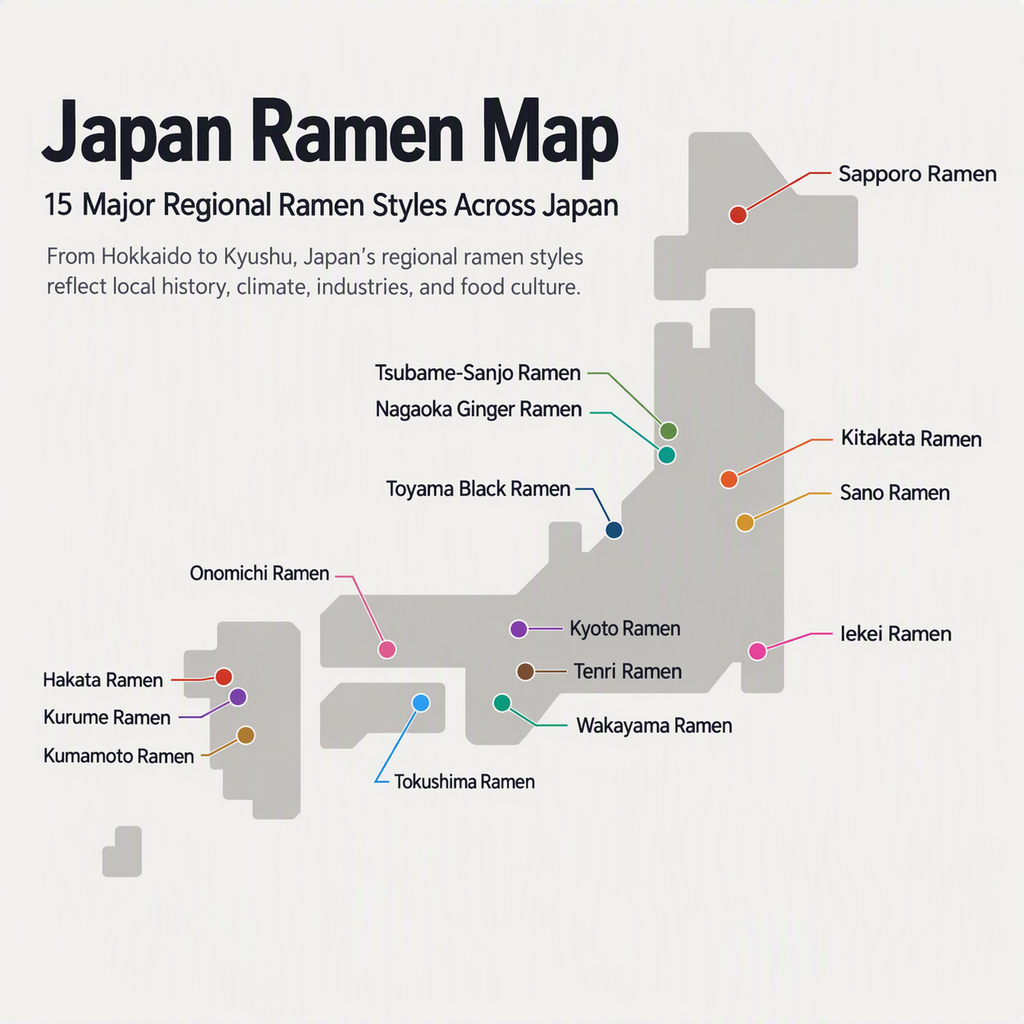
Each region developed its own interpretation of ramen, often influenced by local climate, ingredients, and cultural preferences.
But what exactly changed from place to place?
If you’d like to understand how these regional styles developed, you can also read my article on the history and spread of ramen across Japan.
Where Did Japanese Ramen Come From?
1. Noodles
Many people focus on the broth first, but noodles are just as important.
Different regions use different noodle styles, and those differences can dramatically change the experience of eating ramen.
Comparing Common Noodle Types
| Noodle Type | Representative Styles | Shape | Characteristics | Texture | Heaviness | Soup Adhesion |
|---|---|---|---|---|---|---|
| Extra Thin Straight | Hakata | Very thin, straight | Low water content | Firm, crisp | ★★ | ★★★ |
| Thin Straight | Tokyo Shoyu | Thin, straight | Balanced | Smooth | ★★★ | ★★★ |
| Flat Curly | Kitakata, Sano | Wide, curly | Higher water content | Chewy | ★★★★ | ★★★★★ |
| Medium-Thick Curly | Sapporo Miso | Thick, curly | Designed for rich soups | Springy | ★★★★ | ★★★★ |
| Thick | Ie-kei | Thick | Strong wheat flavor | Chewy | ★★★★★ | ★★★ |
| Extra Thick | Tsubame-Sanjo, Jiro-style | Very thick | Noodles become the star | Dense and hearty | ★★★★★ | ★★ |
Visual Comparison
An interesting pattern appears when these noodles are compared.
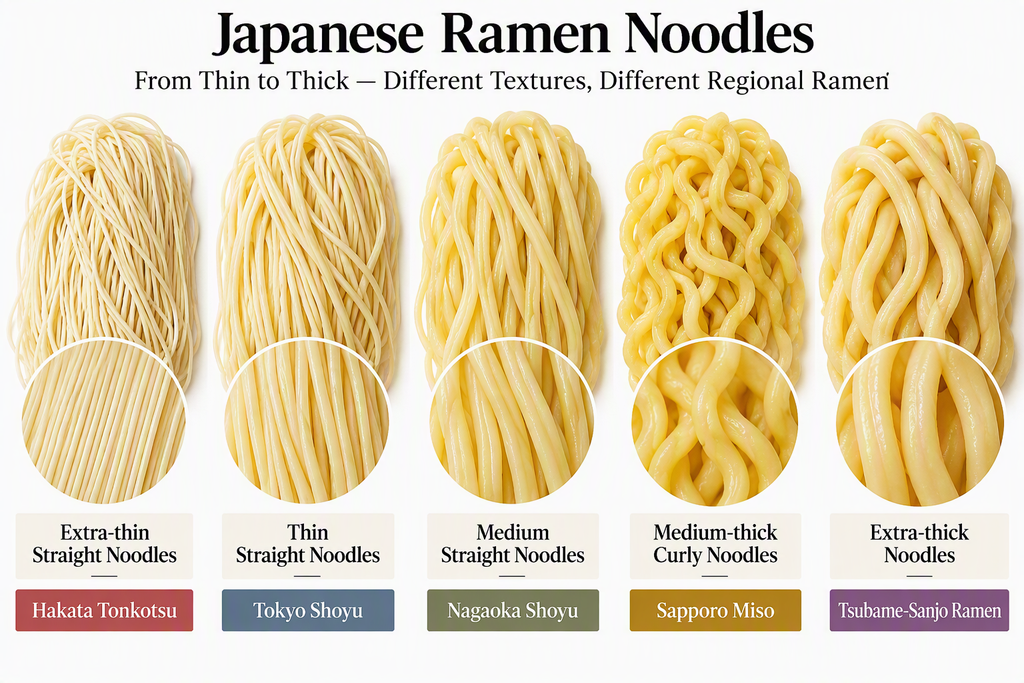
Lighter soups often use curly or flat noodles that can carry more broth.
Meanwhile, richer ramen styles often use thicker noodles with enough presence to stand up to powerful flavors.
There are exceptions, however.
Hakata ramen uses extremely rich pork-bone broth but pairs it with very thin noodles.
This combination became one of the defining characteristics of the style.
Like many things in Japan, there are patterns, but there are also exceptions that make the subject more interesting.
2. Broth
The broth may be the most important element of a bowl of ramen.
While every shop has its own recipe, most broths fall into a few broad categories.
- Chicken-based
- Seafood-based
- Pork-bone-based (Tonkotsu)
- Mixed broths
One discovery surprised me while researching this article.
Many foreign visitors assume that any ramen using pork bones must be tonkotsu ramen.
In Japan, however, that is not necessarily true.
Some Tokyo-style ramen and Kitakata ramen use pork bones as part of their broth.
Yet Japanese people would not classify them as tonkotsu ramen.
Why?
Because tonkotsu ramen is not simply ramen that contains pork bones.
It is ramen designed around pork bones as the main character.
In Hakata and Kurume styles, the broth itself is built to showcase the richness and flavor of pork bones.
The same ingredient can play a very different role depending on how the bowl is designed.
3. Toppings
Despite their differences, many ramen styles share familiar toppings.
The most common are:
- Chashu pork
- Green onions
- Menma (seasoned bamboo shoots)
At the same time, some regions developed toppings that became symbols of their local style.
Characteristic Regional Toppings
| Region / Style | Characteristic Toppings |
|---|---|
| Sapporo | Corn, bean sprouts |
| Tsubame-Sanjo | Pork back fat, onions |
| Nagaoka | Fresh ginger |
| Tokushima | Sweet simmered pork, raw egg |
| Kumamoto | Mayu (black garlic oil) |
These small differences often reflect local tastes and culinary traditions.
Sometimes a bowl of ramen can tell you as much about a region as a history book.
4. Comparing 15 Regional Styles
After looking at noodles, broth, and toppings separately, I tried organizing the fifteen ramen styles from the previous article into a single comparison.
| Style | Region | Noodles | Broth | Signature Toppings |
|---|---|---|---|---|
| Tokyo Shoyu | Tokyo | Thin straight | Chicken, pork, sometimes seafood | Chashu, menma, green onion |
| Kitakata | Fukushima | Flat curly | Pork bone + niboshi, light soy sauce | Chashu, menma, green onion |
| Sano | Tochigi | Handmade flat curly | Chicken and pork | Chashu, green onion |
| Sapporo Miso | Hokkaido | Medium-thick curly | Rich miso broth | Corn, butter, bean sprouts |
| Hakata Tonkotsu | Fukuoka | Extra-thin straight | Pork bone | Chashu, green onion |
| Kurume Tonkotsu | Fukuoka | Thin straight | Rich pork bone | Chashu, seaweed |
| Kumamoto | Kumamoto | Medium straight | Pork bone | Mayu (black garlic oil), fried garlic |
| Kagoshima | Kagoshima | Medium straight | Pork, chicken, vegetables | Green onions, vegetables |
| Onomichi | Hiroshima | Thin straight | Seafood and chicken | Pork back fat |
| Wakayama | Wakayama | Thin straight | Pork bone soy sauce | Kamaboko, green onion |
| Tokushima | Tokushima | Medium straight | Pork bone soy sauce | Sweet simmered pork, raw egg |
| Tsubame-Sanjo | Niigata | Extra thick | Niboshi seafood broth | Pork back fat, onions |
| Nagaoka Shoyu | Niigata | Medium straight | Pork, chicken, soy sauce with ginger | Fresh ginger |
| Yokohama Ie-kei | Kanagawa | Thick straight | Pork bone soy sauce | Spinach, seaweed |
| Nagasaki Champon | Nagasaki | Thick champon noodles | Pork, chicken, seafood | Seafood, vegetables |
5. Looking at the Whole Picture
When viewed individually, each regional ramen seems unique.
But when viewed together, a different picture emerges.
The same ingredients appear again and again.
The same noodle types reappear.
The same toppings travel from region to region.
What changes is the way those elements are combined.
Over time, different regions created their own identities through small adjustments and local preferences.
That may be one of the reasons ramen became such an important part of Japanese food culture.
Each bowl reflects not only ingredients, but also history, geography, and the tastes of the people who created it.
Which Style Would You Try?
Of the fifteen regional styles discussed so far, which one would you most like to try?
Would it be a rich bowl of Hakata tonkotsu?
A hearty bowl of Sapporo miso ramen?
Or perhaps the simple elegance of Kitakata ramen?
A Personal Recommendation
As for Tokyo-style shoyu ramen, my personal favorite is Harukiya in Ogikubo.
After researching ramen for these articles, I find myself appreciating it even more.
Understanding how noodles, broth, and toppings work together doesn’t make ramen less mysterious.
If anything, it makes every bowl more interesting.
Official Website:
Further Reading
- RaiRaiken Returns to Asakusa After 80 Years
- https://www.raumen.co.jp/rapedia/
- The Story of Nagasaki Champon
Image Credits
All illustrations and visualizations in this article were created specifically for this blog using AI-assisted image generation tools.
About This Article
This article combines publicly available historical sources with the author’s own research and interpretation.
Where historical records are incomplete or debated, interpretations are presented as informed perspectives rather than definitive historical conclusions.
SEO Description
Explore the building blocks of Japanese ramen by comparing noodles, broths, and toppings. Learn how 15 famous regional ramen styles differ and discover what makes each bowl unique.