The Story Behind a Bowl of Noodles
Recently, I came across a news article about the revival of Rairaiken, a legendary restaurant in Asakusa often described as one of the origins of Japan’s ramen culture.
Reference:
Rairaiken Returns to Asakusa After 80 Years
Like many Japanese people, I love ramen. Yet I realized that I had rarely stopped to think about where the bowl in front of me came from, or what kind of history had shaped it.
Looking across Japan today, we find Sapporo ramen, Kitakata ramen, Iekei ramen, Hakata ramen, Kumamoto ramen, and many others.
They are all called “ramen,” yet they can look and taste completely different.
So how did that happen?
The revival of Rairaiken inspired me to explore the roots of Japanese ramen.
A Nationwide Food with Many Local Faces
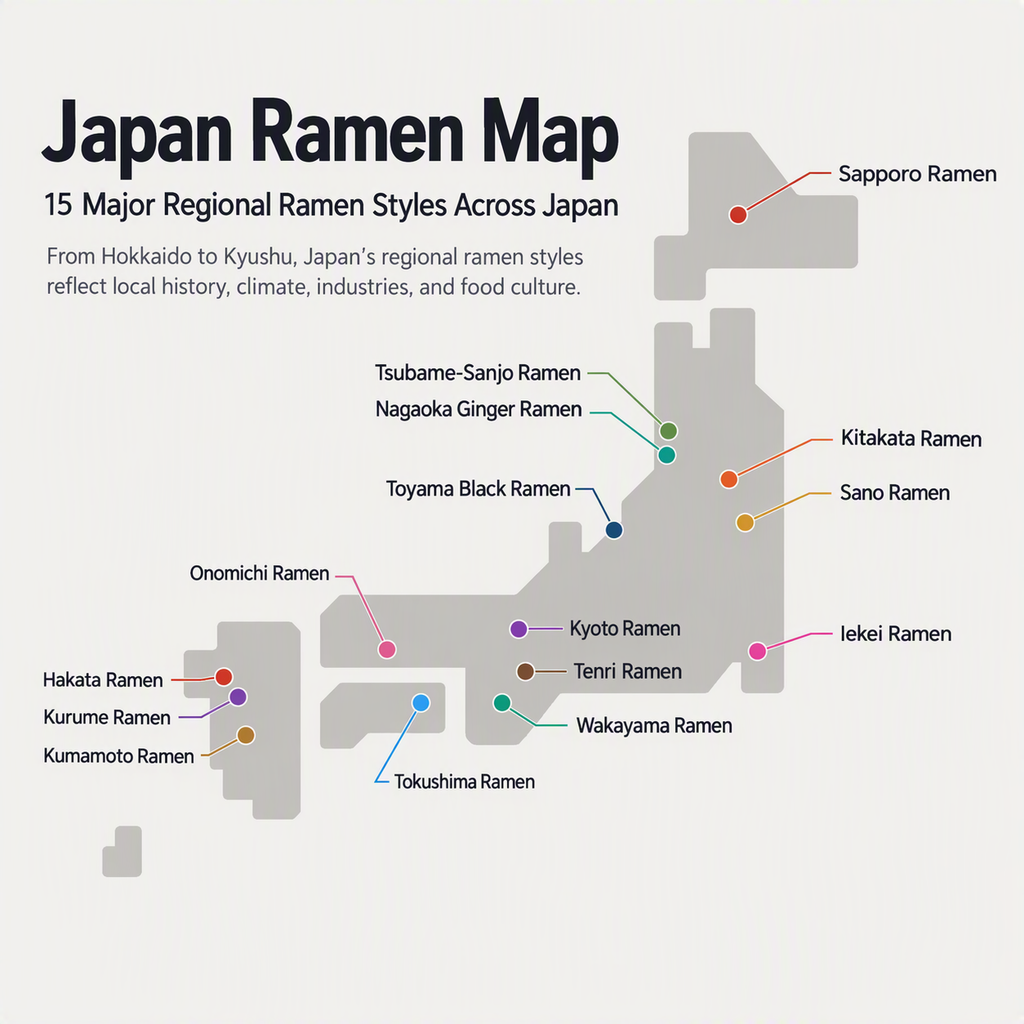
Most visitors to Japan know ramen as one of the country’s signature foods.
What many people do not realize is that ramen is not a single dish.
Regional styles can be found from Hokkaido in the north to Kyushu in the south. Even among the most famous varieties, there are more than a dozen major regional styles, each reflecting local tastes and traditions.
One Name, Completely Different Bowls
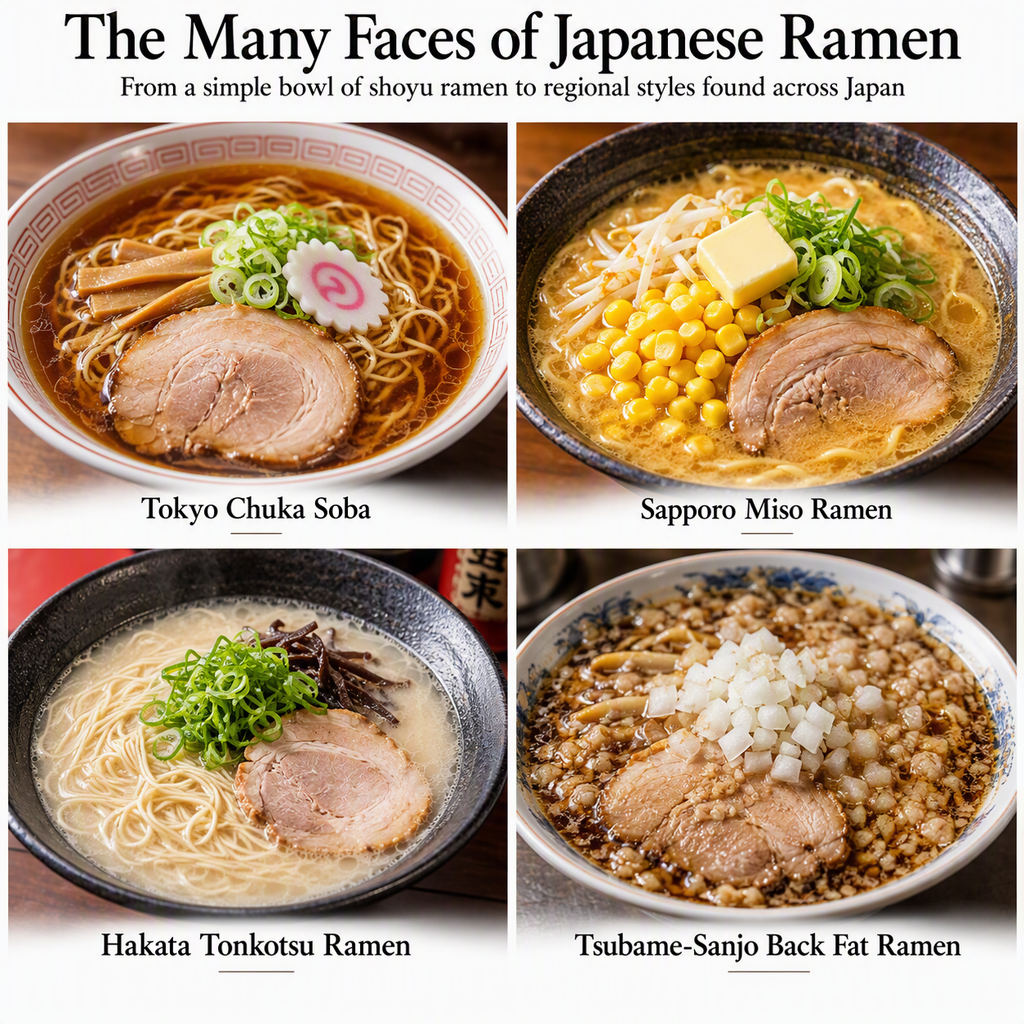
Take a look at these four bowls.
A traditional Tokyo-style chuka soba.
A rich Sapporo miso ramen from Hokkaido.
A creamy Hakata tonkotsu ramen from Fukuoka.
A Tsubame-Sanjo ramen from Niigata covered with pork back fat and diced onions.
At first glance, it is hard to believe they all belong to the same category of food.
Yet somehow, they are all ramen.
This raised an even more interesting question.
If these bowls are so different, do they share any common roots?
Tracing the Origins
Ramen originally came from Chinese noodle dishes.
One of the most influential early restaurants was Rairaiken, founded in Tokyo in 1910. It helped popularize a Japanese adaptation of Chinese noodles and is often regarded as a starting point for modern ramen culture.
From there, the story becomes surprisingly complex.
When I started researching, I assumed every regional ramen had been invented independently.
Instead, many of them appeared to be connected.
Kitakata and Sano seem to preserve many characteristics of traditional shoyu ramen.
Meanwhile, places such as Sapporo, Tsubame-Sanjo, Nagaoka, Toyama, Onomichi, and Tenri appear to represent regional adaptations of that original style.
Kyushu followed a different path. Over time, pork-bone ramen traditions developed in the region, eventually leading to Kurume, Hakata, and Kumamoto ramen.
Later still, other regional styles seem to have emerged where shoyu and tonkotsu traditions met and blended.
One Possible Way to View Its Evolution
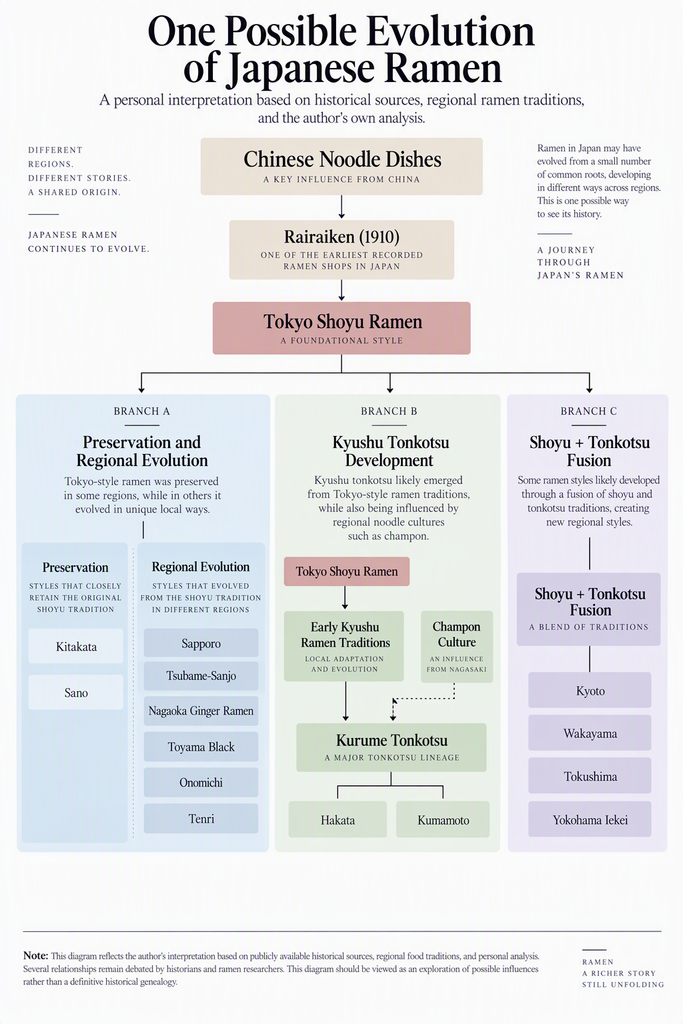
The following diagram reflects my personal interpretation based on publicly available historical sources, regional food traditions, and my own research. Some relationships remain debated, and the diagram should be viewed as an exploration rather than a definitive history.
Whether every connection is historically correct is open to debate, but viewing ramen this way helped me understand why such different bowls can still feel connected.
More Than Just Noodles
What surprised me most was realizing that ramen is not simply a dish imported from China.
In cold regions, miso became important.
In industrial towns, extra fat was added to provide energy and warmth.
In port cities, local ingredients and trading networks shaped new flavors.
In Kyushu, pork-bone broth evolved into a world of its own.
And even today, ramen continues to evolve through new fusions and creative interpretations.
What began as a relatively simple noodle dish has grown into a vast culinary ecosystem.
Final Thoughts
The next time you visit Japan and order a bowl of ramen, I hope you do more than simply enjoy the taste.
Take a moment to wonder where that bowl came from, who created it, and how it evolved.
Behind every bowl lies a story of climate, industry, local culture, and generations of people who shaped it.
In that sense, ramen is more than a meal.
It is a small piece of Japan’s history served in a bowl.
Further Reading
- Rairaiken Returns to Asakusa After 80 Years
- https://www.raumen.co.jp/rapedia/
- The Story of Nagasaki Champon
Image Credits
All illustrations and visualizations in this article were created specifically for this blog using AI-assisted image generation tools.
About This Article
This article combines publicly available historical sources with the author’s own research and interpretation. Where historical records are incomplete or contested, interpretations are presented as informed hypotheses rather than definitive historical conclusions.
SEO Description
Where did Japanese ramen come from? Explore how a simple bowl of shoyu noodles evolved into regional styles such as Sapporo miso ramen, Hakata tonkotsu ramen, and many others across Japan.
コメントを残す